
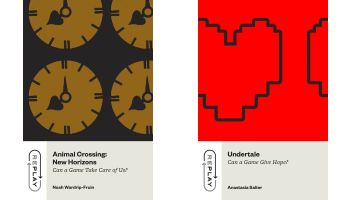

Boss Fight Books might have some competition thanks to the recent launch of a similar, though more academically-inclined, series from University of Chicago Press. Books from the publisher’s Replay series will attempt to connect the personal experiences of the author with “gameplay with insights into a game’s development, reception, and implications for contemporary social life.”
Replay is a series of short general interest books, each about a single game. Accessible and engaging, the books connect authors’ personal experiences of gameplay with insights into a game’s development, reception, and implications for contemporary social life. A book about Animal Crossing: New Horizons might explore how the game offered safety and social connection during the COVID-19 pandemic; another, about the location-based Pokémon GO, might investigate urban gentrification; yet another, about Windows Solitaire, might probe the relationship between preinstalled desktop software and computer literacy. We invite any author who has a deep connection to a game and can express both relatable and surprising observations to a wide audience. Our first proposals have come from journalists and scholars with expertise in queer and feminist game criticism, Black studies, and Native American studies.
Replay launched this month with two books, Animal Crossing: New Horizons – Can a Game Take Care of Us? and Undertale – Can a Game Give Hope?. Future volumes are expected to focus on Pokemon Go, Windows Solitaire, and other games.
You can learn more about both books after the break.
Animal Crossing: New Horizons – Can a Game Take Care of Us? was written by Noah Wardrip-Fruin, a professor at UC Santa Cruz and the author of How Pac-Man Eats. Wardrip-Fruin tries to answer the question found in the book’s subtitle, while also wondering “Do we want it to?”
Animal Crossing: New Horizons was released on March 20, 2020—just as a pandemic kept many from family, work, restaurants, and the rest of their regularly scheduled lives. At its height, the game averaged one million copies sold per day, as players sought comfort, escape, and a virtual means of connection. In this book, game scholar Noah Wardrip-Fruin, isolated with his family by both lockdown and disability, explores the power of this game and the mixed emotions of a player and a parent trying to make it from one day to the next—while his kids’ obsession with Animal Crossing creates conflicts between them and pushback against family rules.
Wardrip-Fruin helps both Animal Crossing fans and newcomers understand the unexpected beneath the game’s surface: like the story of the first Animal Crossing, codesigned by an absent father seeking connection; like the hallmarks of video game manipulation, from “streak” bonuses to game-determined playtimes; like the appeal of endless shopping, in a kind of “safe” capitalism; and, of course, like the character quirks of a raccoon dog, Tom Nook, who provides a world of both safety and strange paternalism.
For many, this blockbuster game offered a comforting world compared to a reality of danger. In this first entry in the Replay series, Wardrip-Fruin offers an absorbing investigation of a game’s role in contemporary social life and a book that belongs on the shelf of anyone who loves or is puzzled by this Nintendo sensation.
Undertale – Can a Game Give Hope? was written by Anastasia Salter, a professor at the University of Central Florida and the co-author of Flash: Building the Interactive Web. Salter’s history with unorthodox games gets at the heart of Undertale by asking “What makes a real game? Who is a gamer? And what type of play do we value?”
On the surface, the 2015 game Undertale didn’t seem like much, supported by fan funding and with minimalist retro graphics. But despite its pixelated monsters and dated role-playing mechanics, Undertale invited fans and players to rethink their very relationship with gaming and game characters. Players encountered an extraordinary range of possible play experiences, with paths through the game’s unassuming world leading to both empathy and extreme violence, offering room for reflection and growth. Players could befriend (sometimes queer) monsters or kill them, for instance, appealing to each monster’s unique personality to negotiate survival and find community.
Contextualizing this game’s success in the wake of the Gamergate online harassment campaign and meditating on questions of violence and authenticity, writer and game scholar Anastasia Salter offers a profound exploration of this game sensation and a personal story of hope at a time when Salter was otherwise “done” with games. Undertale’s unique structure helped make it synonymous with “indie” games, built outside of the studio as a passion project and inspiring similar passion among its many fans even a decade later. But Undertale’s story also speaks to an auteur dream: What game developer Toby Fox and his collaborators accomplished on a small budget, with relatively simple tools, has left people replaying, arguing, and creating in its wake.
As we enter a cultural moment where intense interest is shifting towards flashy creativity, powered by generative artificial intelligence, Undertale reminds fans and newcomers of the power of thoughtful and intentional human design.
Animal Crossing: New Horizons – Can a Game Take Care of Us? and Undertale – Can a Game Give Hope? are now available from your local bookstore in paperback and online as ebooks.