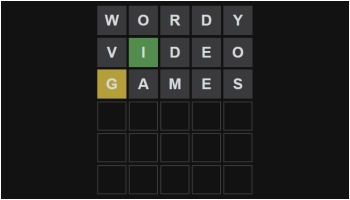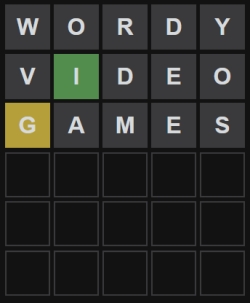
The History of Wordle: A Story in Nine Tweets

Every so often, a game comes along with a certain something that just completely captures the public’s fascination. It happened in 2006 with Wii Sports and its introduction of motion controls. It happened in 2007-2008 with Guitar Hero and Rock Band, a pair of games that seeded plastic instruments in living rooms across the world like some kind of Johnny B. Rockstar. It happened in 2016 with Pokemon Go, a game that encouraged players to go outside and explore the real world.

And for the last few months, it’s been happening with Wordle.

[Continue Reading…]

Bite-Sized Game History: Video Games at the 2021 Hugo Awards, Shining in the Darkness’s Hobbit Problem, and RIP John Madden

The Hugo Awards are arguably the most prestigious prize in the science fiction and fantasy community, but it took until 2021 for the members of Worldcon (AKA the World Science Fiction Society) to finally recognize video games with an award of their own.

In this edition of Bite-Sized Game History, we’ll look at the Hugo’s first foray into video games, as well as another example of gaming’s lax recognition of copyright law, and say goodbye to the man who defined how football was meant to be played as a video game.

[Continue Reading…]

Warren Davis Relives His Career in “Creating Q*bert and Other Classic Video Arcade Games”

Warren Davis spent two decades in the game industry and he is ready to talk some @!#?@!.

The game developer got his start at Gottlieb in the early 1980s and is best known as the creator of Q*bert. Believe it or not, in a nod to the nonsensical “swearing” uttered by the main character, that oddball arcade game was originally known as @!#?@!.

The story of that name change, and more interesting episodes from Davis’s career, can be found in his new memoir, Creating Q*bert and Other Classic Video Arcade Games, which was published late last year by Santa Monica Press:

Creating Q*bert and Other Classic Video Games takes you inside the video arcade game industry during the pivotal decades of the 1980s and 1990s. Warren Davis, the creator of the groundbreaking Q*bert, worked as a member of the creative teams who developed some of the most popular video games of all time, including Joust 2, Mortal Kombat, NBA Jam, and Revolution X.

In a witty and entertaining narrative, Davis shares insightful stories that offer a behind-the-scenes look at what it was like to work as a designer and programmer at the most influential and dominant video arcade game manufacturers of the era, including Gottlieb, Williams/Bally/Midway, and Premiere.

Whether you’re looking for insights into the Golden Age of Arcades, would like to learn how Davis first discovered his design and programming skills as a teenager working with a 1960s computer called a Monrobot XI, or want to get the inside scoop on what it was like to film the Rock and Roll Hall of Fame band Aerosmith for Revolution X, Davis’s memoir provides a backstage tour of the arcade and video game industry during its most definitive and influential period.

After Gottlieb, Davis spent most of his career at Midway, providing assistance on groundbreaking arcade classics such as Mortal Kombat, Terminator 2: Judgment Day, and NBA Jam. Not only did he help make “digitized graphics” a household phrase, but he even got one of his former co-workers, Mortal Kombat co-creator Ed Boon, to pen the Foreward for Creating Q*bert.

Creating Q*bert and Other Classic Video Games was released in November and should be available wherever you get your books.


Bite-Sized Game History: Pepsiman’s Brief Encounter with The Blue Meanie, Rockstar’s Prototype Logos, and RIP to Masayuki Uemura

With the right circumstances, it’s possible for a logo to break free from the company it represents and become an iconic piece of history in its own right. It’s easy to point to Nintendo, PlayStation, and Xbox as some of the most prominent examples in gaming, but they’re not the only ones.



Bite-Sized Game History is back with the working designs of one such logo, as well a former wrestler’s previously-unknown connection to one of the most infamous games of the 1990s, and a farewell to an influential engineer you might not know.

[Continue Reading…]

The Legend of Zelda: Breath of the Wild is #1 in IGN’s 2021 Update to Their “Top 100 Games of All Time”

Just a few months after hosting a “Best Video Game of All Time Bracket” for their readers, IGN is back with the latest update to their staff-curated “Top 100 Games of All Time” list.

Games in our top 100 have to measure up to a few key metrics: how great a game it was when it launched, how fun it is to still play today, and how much the game reflects the best in its class. While past versions of this list have put a big emphasis on a game’s impact and influence, we’ve essentially taken that out of the equation. Many games that left a mark and inspired future developers may not stand the test of time and be all that fun to play right now. Or, quite simply, they may have been surpassed by other games.

With all of that said, IGN’s list reflects the current staff’s 100 best games of all time – a collection of games that continue to captivate us with their stories, wow us with their revelatory approach to game design, and set the standards for the rest of the industry.

This year’s update is the seventh iteration of the list, which was first published all the way back in 2003. That group of editors and staff writers chose Super Mario Bros. for as the greatest game of all time. Mario’s first super-sized adventure is still hanging around the upper reaches of IGN’s list (it’s at #21), but a different Nintendo-published title claimed the top spot in 2021.

[Continue Reading…]

Japan’s TV Asahi Unveils the Top 100 from “50,000 People Vote! The Video Game General Election”

It’s something of a rare occurrence for journalists in Japan to produce a list of the best games of all time. Typically, this process is turned over to the public, with the results hinging on huge write-in campaigns from passionate fans across the country. Such was the case earlier this week, when TV Asahi aired “50,000 People Vote! The Video Game General Election” just after Christmas.

As you might have guessed from the name of the special, TV Asahi polled more than 50,000 viewers to create their list. You’ll probably also be unsurprised to find out that games from Japanese developers dominated the Top 100. Nintendo-published titles accounted for nearly half the list (42 in all) and Square Enix (with 25 entries) wasn’t too far behind.

Stepping beyond those two powerhouses, you’ll find a smattering of games from Atlus (including Persona 5 and Persona 5 Royal), as well as a handful from Capcom (most notably, a quartet of games from the Monster Hunter series). In the end, just six titles from the list were developed outside of Japan (Respawn’s Apex Legends, Behavior’s Dead By Daylight, Sucker Punch’s Ghost of Tsushima, Mojang’s Minecraft, Alexey Pajitnov’s Tetris, and Toby Fox’s Undertale).

The full list was helpfully transcribed by Famitsu, and you can find it below (North American translations are used when available).

[Continue Reading…]

National Videogame Museum Launches “The Animal Crossing Diaries” Podcast

The unique world that players inhabit in Nintendo’s Animal Crossing: New Horizons has helped a lot of people cope with the events of the last two years, and the curators at the National Videogame Museum have embedded themselves within this welcoming community, collecting stories from the public for their excellent Animal Crossing Diaries online exhibition.
Recently, the UK-based museum expanded their oral history project with the launch of The Animal Crossing Diaries podcast on Spotify.

[Continue Reading…]

Shacknews Launches the Shacknews Hall of Fame With a Massive Inaugural Class

GameSpot and IGN changed the video game media landscape after they debuted in 1996, but did you know there’s another site celebrating a quarter-century on the journalistic front lines this year?


Shacknews began life as a Quake fansite before growing into a full-service news portal and file directory in the early 2000s. The site was briefly owned by GameFly a decade ago and is best-known today as the destination for David L. Craddock’s fantastic Long Reads series. I’m guessing this newfound focus on game history served the editorial team well when they launched the Shacknews Hall of Fame last week.

Honoring not just games, the Shacknews Hall of Fame also exists to shine a spotlight on the creators, platforms, technology, and publications that built the game industry into what it is today:

[Continue Reading…]

Celebrate 20 Years of Xbox With the Microsoft-Produced “Power On: The Story of Xbox” Documentary Series

Microsoft’s anniversary celebration for the Xbox has reached its final form with the release of Power On: The Story of Xbox, a new six-part documentary series.

Power On was produced in-house by Microsoft and it promises to tell the full story (“glitches and all”) behind the creation of the original Xbox. Bungie’s Halo: Combat Evolved gets the spotlight in the fourth episode, and viewers who stick with the series to the end will be able to dive into the fallout from some of Microsoft’s costly mistakes, with two final episodes devoted to the Xbox 360’s Red Ring of Death and the Xbox One’s TV-centric debut.

[Continue Reading…]

Wata Games Publishes First Population Report of Graded Games

During the last two years, Wata Games and Heritage Auctions have positioned themselves at the forefront of the retro gaming boom. But while demand has skyrocketed, the two companies have come under fire recently for possibly engaging in self-dealing and price manipulation. In the wake of these claims, the market for retro games (especially sealed titles graded by Wata Games and sold by Heritage Auctions) has cooled considerably.

In an attempt to be more transparent with the general public, Wata Games rolled out their first-ever Population Report for NES Games last week. This report includes a full count of every NES game Wata has graded (and any packaging variants available), as well as how many copies exist within each grade. From there, it should theoretically be easy to determine just how rare a given copy really is by matching data from the report to sales listings.

Deniz Kahn, the President of Wata Games, introduced the Population Report in the company’s Email Newsletter:

The team at WATA is excited to share with you our first-ever Population Report. This initial release is centered on Nintendo Entertainment System (NES) games and we will be expanding the report to include games from other systems in the coming months. We are putting the finishing touches on a full, dynamic population report – including all games and grading categories – by early next year and we can’t wait to share that with you.

To zero in on a recent high profile example, we can see the copy of Super Mario Bros. that was recently sold by Rally for $2 million is currently the only copy of the game with a “hangtab” variant to receive a grade of 9.8 from Wata. Does that make it worth $2 million? I don’t know. But it is very useful information to have if you’re a collector.

Kahn also confirmed that Population Reports for all platforms would be coming soon:

Q: Why not wait to release a full Pop Report?
A: We felt compelled to share something of note with our collecting community now and while this is by no means a full picture, it does provide a solid look at grading stats for NES games. This particular report is a limited, temporary effort while we work on the more robust process of generating dynamic Pop Reports for all systems.

The release of their first Population Report doesn’t answer all the questions swirling around Wata Games, but it does give the public a slightly better overview of what the market for graded retro games actually looks like.